






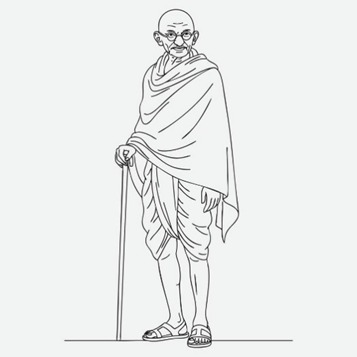
October 2 has passed. The nation remembered Mahatma Gandhi. Prayer meetings were held, floral tributes were offered at his statues, and cleanliness drives were organised to recall his ideals. Newspapers and social media carried discussions on Gandhi’s life, philosophy and message.But after October 2, one question remains before us: Was Gandhi with us only until October 2? This is not merely a question about Gandhi’s relevance. It is a question about the moral character of our times.Remembering Gandhi is easy. Recognising his photograph is easy. Delivering speeches in his name is not difficult either. But reading Gandhi, engaging with his ideas even when we disagree with him, and confronting the difficult questions raised by his life are far more demanding.Perhaps Gandhi is needed most not on the day when the entire nation remembers him, but on the day when we stand alone before one of our own decisions and have to choose between convenience and truth.For me, Gandhi remains a living presence in precisely this sense.
During my university education, I had the opportunity to study Gandhi’s ideas and writings closely. As a student, my introduction to Gandhi began with the pages of history, but his original writings gradually transformed that introduction into a serious intellectual and personal dialogue.While reading Hind Swaraj, I felt that Gandhi was not merely questioning colonial rule; he was also questioning the direction of modern civilisation, which we often equate with progress.Reading The Story of My Experiments with Truth revealed another Gandhi. Here was not an unquestionable or flawless figure, but a human being who recognised his weaknesses, acknowledged his mistakes and repeatedly tested his life against the standards of truth.What influenced me most in Gandhi’s writings was this spirit of self-examination.He did not present his life as the final truth. He called it an experiment. That word—experiment—is one of the important keys to understanding Gandhi. An experiment allows for mistakes. It allows for correction. It is less concerned with proving oneself right than with moving closer to the truth.At a time when we are often more interested in proving our opinions correct, Gandhi’s “experiments with truth” offer a different discipline—the discipline of making one’s ego smaller before the truth.
Also Read: Villages Have Houses, But Where Has the Village Spirit Gone?
We live in an age of extraordinary technological advancement. Information travels from one corner of the world to another within seconds. Access to knowledge and educational resources has never been greater.Yet some old questions have returned in new forms.
Why is violence increasing? Why does disagreement so quickly turn into hostility?
Why is it becoming increasingly difficult to distinguish truth amid an explosion of information? Why does inner restlessness persist despite material prosperity?And who ultimately pays the price for nature in the race for development?It is amid these questions that Gandhi reappears.Gandhi does not offer ready-made answers to all the problems of our time. Instead, he teaches us how to turn our problems into the right questions. Perhaps that is one of the deepest ways in which he remains relevant.
For Gandhi, truth was not merely a word used in speeches. Truth was a test of life.Today, the crisis of truth is not limited to telling lies. The deeper challenge is that we often want to hear only what conforms to our convenience, assumptions and prejudices.The digital age has made this crisis even more complex. Unverified information spreads rapidly. It takes only seconds to form an opinion about a person or an event, but reaching the truth requires time, judgment and patience.In this context, Gandhi’s idea of truth remains relevant. Verifying information before sharing it is a way of respecting truth. Accepting a mistake when it is exposed is also an act of truth. Accepting that “I may be wrong” is itself part of the search for truth.
Gandhi does not merely teach us to speak the truth; he teaches us to be prepared to change ourselves in the pursuit of truth.
Gandhi’s idea of non-violence is often discussed in the context of war and political struggle. But perhaps today it needs to begin with our words.How quickly does disagreement on social media turn into insult?Is it fair to define an entire person by a single opinion or statement?Gandhi’s idea of non-violence asks us to pause here.Non-violence is not merely the absence of physical harm. It is also the recognition of the dignity of another person.Therefore, Gandhi’s non-violence is relevant not only to a world struggling with conflict and war, but equally to our personal and social lives.
Today’s younger generation is ambitious. That is a positive quality. But alongside ambition, there must also be a question: **What kind of path are we taking to reach success?**Gandhi’s life places this question before young people.
The destination matters, but the path by which we reach it matters no less.
The difference between a small achievement earned honestly and a major achievement gained through unethical means is not merely a matter of moral instruction. It is a question of individual character and the future of society.The younger generation can read The Story of My Experiments with Truth from this perspective.Gandhi teaches us not to fear failure, but to learn from it. He reminds us that self-discipline is not the opposite of freedom; it can be one of its foundations.And, most importantly, he reminds us that change must begin not with others, but with ourselves.
We have remembered Gandhi enough. Now we need to read him more deeply.We need to move beyond his photographs and return to his books. We need to read Hind Swaraj. We need to read The Story of My Experiments with Truth. We need to read his letters, writings and speeches.We need to question him.We need to disagree with him as well.Because Gandhi can remain alive not by protecting him from criticism, but by keeping him within a continuing process of criticism and dialogue.When a historical figure is made so great that the next generation is no longer allowed to question him, we risk turning that person into a fixed monument of history.Gandhi should not be made static. He should remain alive.And a living idea is one with which dialogue continues.
Perhaps the most meaningful day of Gandhi Jayanti is not October 2, but some day after October 2.The day when a young person opens a chapter of The Story of My Experiments with Truth.The day when someone pauses before forwarding unverified information on social media.The day when someone listens completely to an opponent.The day when someone accepts a mistake.The day when someone stands up for the rights of a vulnerable person.And the day when, before demanding that others change, we ask ourselves:**Can the change begin with me?**My years of studying Gandhi’s writings have given me an opportunity to understand that Gandhi cannot be confined to a single definition. He was a political thinker, a social philosopher, a moral experimenter and, above all, a human being who made his own life a laboratory for his ideas.
Gandhi is not a person confined to a monument. He returns whenever human beings face a choice between convenience and truth, violence and non-violence, self-interest and responsibility, rights and duties.Therefore, after his 157th birth anniversary, Gandhi does not merely need to be remembered once again.
We need to read Gandhi again.
We need to disagree with him.
We need to engage in dialogue with his ideas.
And, above all, we need to transform his “experiments with truth” into small experiments in our own lives.
October 2 has passed.Now Gandhi should be visible in our conduct.Because the greatest meaning of remembering a great person does not lie merely in placing flowers before his photograph. It lies in allowing his ideas to bring even a small change in our own lives.Perhaps that is why Gandhi is part of our history, yet is not merely history.
Gandhi is not simply a memory of a bygone era—he remains a moral necessity for every changing age.
The views and opinions expressed in this article are those of the author.
Dr. Randhir Kumar
Educationist and National President of NHRCCB, a human rights organization.
