





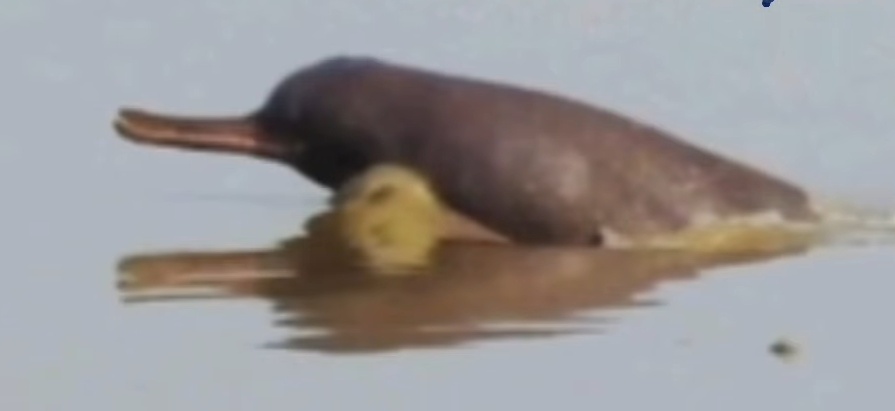
Bhagalpur: A sudden stir ripples through the ceaseless flow of the Ganges. A sleek, grey body breaks the water’s surface, leaps into the air, and vanishes back into the depths in the blink of an eye. This thrilling spectacle unfolds within the Vikramshila Gangetic Dolphin Sanctuary, stretching from Sultanganj to Kahalgaon in Bhagalpur.
While the playful antics of this National Aquatic Animal above the water captivate tourists, the situation beneath the surface remains a cause for concern among experts. Although dolphins are still present in the sanctuary, significant challenges regarding their natural habitat and breeding have emerged.
Also Read: Over 100-Year-Old Setua Family Kali Puja Keeps Midnapore’s Religious Heritage Alive
Around 200 Dolphins, but Breeding Concerns Persist
According to Forest Department monitoring and available data, the dolphin population in the approximately 60-kilometer stretch between Sultanganj and Kahalgaon hovers around 200. However, experts do not view this situation as entirely satisfactory.
They note a disproportionate decline in the number of adult male dolphins in recent times. Simultaneously, the number of newborn dolphin calves in this stretch of the Ganges is not seeing the expected increase.
Experts warn that if the new generation does not grow in number, the population could face a sudden decline in the future as the existing dolphins age.
Also Read: Lack of Basic Amenities in a 104-Year-Old School; Children Forced to Sit on the Floor to Study
Concerns Over Breeding Cycles and Pollution
Dolphin expert and environmentalist Dr. Sunil Chaudhary states that the reduction in the number of male dolphins could impact their breeding cycle. He emphasized that dolphins are highly sensitive aquatic creatures for whom a quiet and safe environment is essential. They also identified the banned nylon ‘current nets’ as a serious threat to dolphins; getting entangled in such nets can prove fatal for them.
Furthermore, the noise from the increasing number of commercial boats and large motorized vessels in the Ganges poses a challenge for dolphins. Dolphins rely on echolocation—using sound waves—to navigate and hunt. Excessive underwater noise can disrupt this natural mechanism, leaving them disoriented and stressed.
‘Dolphin Friends’ Keeping Watch
Awareness campaigns regarding dolphin conservation are being conducted by the Forest Department and local voluntary organizations. People in riverside villages and fishing communities are being sensitized to dolphin conservation through community gatherings (chaupals).
Local youths are being trained as ‘Dolphin Friends’ (Dolphin Mitra). These young individuals help monitor and report instances of poaching and the use of banned nets.
The fishing community is being educated on the fact that dolphins are vital indicators of the Ganges’ ecological health. Simultaneously, they are being encouraged to use traditional cotton-thread nets.
Maintaining Minimum Water Levels and Controlling Noise is Crucial
The presence of dolphins in the Ganges at Bhagalpur is a significant natural heritage for the region. Experts believe that awareness campaigns alone will not suffice to address the challenges of conservation.
Ensuring a safe future for dolphins requires attention to measures such as maintaining minimum water levels in the Ganges, mitigating siltation, controlling pollution, and limiting aquatic noise. If these challenges are not addressed in time, there is a risk that, for future generations, the Ganga’s unique playful antics will be confined to books and videos rather than being witnessed in reality.

Related News
- Special News Over 100-Year-Old Setua Family Kali Puja Keeps Midnapore’s Religious Heritage Alive
- Special News Lack of Basic Amenities in a 104-Year-Old School; Children Forced to Sit on the Floor to Study
- Special News Over 62 lakh families benefit from PM Surya Ghar Yojana; ₹33,904 crore subsidy released
- Special News Veer Shivaji Hockey Academy: Born from a Young Man’s Vision; Showing a New Path to Over 52 Players Free of Cost