




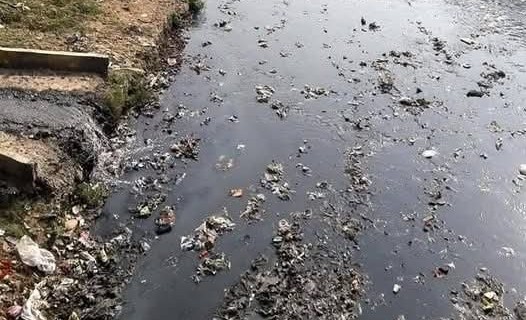
My elder brother, Prakash Sahay, has brought to light a deeply distressing picture of the plight of Ranchi’s Harmu River—one that would unsettle anyone with even a trace of sensitivity. During his childhood, the river would swell during the monsoon, flooding several neighbourhoods. Children would bathe in its waters, learn to swim, and people regarded it with the respect accorded to a river. Today, the situation is such that there is not even enough clean water in it to drown one’s nose. What flows through it now is little more than filthy wastewater discharged from the drains of surrounding houses. Plastic and garbage have taken over its course. This is not merely the story of a river; it is also a story of our collective mindset, our administrative failure, and our growing insensitivity.
If you are a resident of Ranchi, or have ever visited the city, you must have noticed Harmu Road, Harmu Colony and even Harmu Mukti Dham. Yet the bitter truth is that it is the Harmu River itself that most desperately needs liberation. There is an irony here that borders on satire: the very river along whose banks life once flourished now carries polluted water beside which cremations are performed. Harmu is no longer a river. It has died. When a river is reduced to a drain, it is not merely the water that dies—the future of the city dies with it. The groundwater table sinks deeper into the earth, almost in shame. Temperatures rise, and then millions are spent in the name of restoring the river, often becoming little more than an exercise in financial mismanagement.
Also Read: Forest Ecosystem Services in India Worth $2.5 Trillion
I am referring to 1994-95. At the time, I was studying journalism at Ranchi University. I had travelled to Ranchi for the first time from my home district of Gaya. The city’s beautiful hills and lush greenery gave one an almost heavenly impression. The Harmu River played a significant role in that landscape because it was the backbone of the city’s natural drainage system. Originating in the plateau region of Nagri, the river flows for nearly 40 kilometres before meeting the Subarnarekha River near Chutia. In those days, its water was clean. During festivals such as Chhath, devotees would gather along its banks to offer prayers. Even during summer, the river retained water. In the monsoon, its vigorous flow was a source of excitement for local residents. Today, when even light rainfall leaves Ranchi’s roads submerged, while summers bring desperate water shortages, one begins to understand just how expensive the destruction of the river has become.
History, too, bears testimony to Harmu’s significance. In 1939, it was on the banks of this very river that the Adivasi Mahasabha conference gave an organised voice to the demand for a separate Jharkhand state. Under the leadership of Marang Gomke Jaipal Singh Munda, the movement acquired a new direction from here. The river that once witnessed and preserved a defining chapter in Jharkhand’s political history has now been reduced to a filthy drain.
The question is: who killed Harmu? The answer is straightforward—successive governments, the administration, and all of us, collectively. The city expanded, colonies sprang up, natural drainage channels were filled in, encroachments spread along the riverbanks, and household sewage began flowing directly into the river.
Also Read: Humid Heat Stress in India: A Growing Climate Threat
Prakash Sahay is also deeply distressed by the fact that more than ₹150 crore has reportedly already been spent on the so-called rejuvenation of Harmu. Embankments were constructed, pedestrian pathways were built, railings installed, the surroundings were painted and beautified, and photographs were taken. Yet the river remains a drain. That is because a river cannot be brought back to life with concrete, tiles and decorative lights. To remain alive, it needs clean water, an uninterrupted flow and freedom from encroachment. If sewage continues to pour into it unchecked, beautification will remain confined to government files and inauguration ceremonies.
If Harmu is to be saved, the effort must move beyond cosmetic beautification. The discharge of sewage must be stopped completely. Encroachments must be removed, and the river must be restored to its natural catchment area. Ordinary citizens, too, have an equal responsibility. The day people stop treating the river as a dumping ground will mark the beginning of its rebirth.
Harmu stands before us as a question: will we leave the next generation a living river, or merely its photographs and its history? The government must answer that question, but so must each one of us.
Story by: Arvind Sharma
(Photograph: From the wall of Prakash Sahay Ji)