







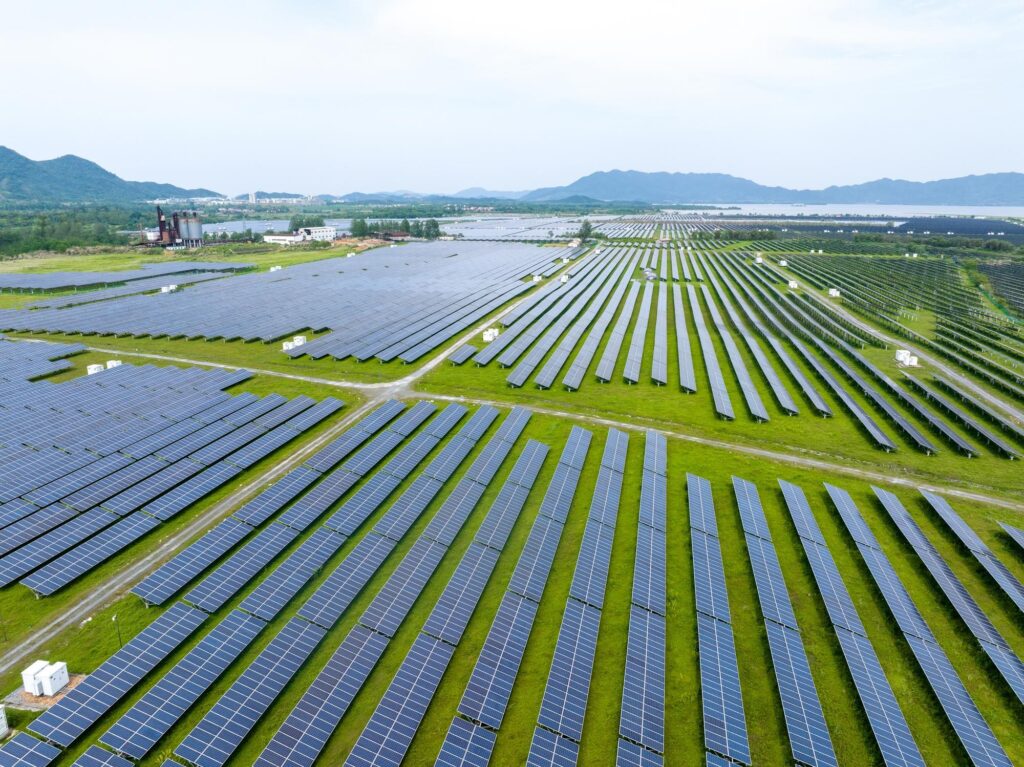
A NITI Aayog report has revealed a major development concerning India’s solar energy sector. Despite having around 100 GW of manufacturing capacity, India continues to depend on China for imports of key solar components. The report also highlights the challenges ahead and the steps needed to reduce this dependence.
India has achieved a major milestone in the renewable energy sector. According to the latest NITI Aayog report, India’s solar module manufacturing capacity has surged from just 2.3 GW in 2014 to a record 100 GW by August 2025. However, behind this significant achievement lies a major challenge: India still depends on other countries, particularly China, for several raw materials and components required to manufacture solar panels.
Also Read: On November 16, Delhi Metro will begin operations for Chhath Puja at 4:30 AM
How Significant Has India’s Solar Energy Growth Been?
India’s solar power capacity has expanded rapidly over the past decade. Between financial years 2015 and 2025, the country added 103 GW of solar power to its grid, taking its total solar energy capacity to 106 GW by March 2025.
India has set an ambitious target of reaching 280 GW of solar capacity by 2030. This means the country will need to add another 174 GW of capacity over the coming years, which is expected to significantly increase domestic demand for solar components and equipment.
According to NITI Aayog, India’s solar manufacturing sector is largely limited to the assembly of solar cells and modules. The country has a very limited presence in the early stages of solar panel production, including polysilicon, ingot and wafer manufacturing.
Also Read: 96.47 kg Ganja Seized at Assam-Arunachal Border, Vehicle Driver Absconds
The absence of large-scale wafer manufacturing and limited cell production capacity means Indian manufacturers continue to rely heavily on imports to meet their requirements.
China has a dominant position in the global solar manufacturing industry. As of December 2024, China accounted for more than 80% of the world’s total solar manufacturing capacity. This dominance was reflected in India’s imports as well, with China accounting for around 59% of India’s total solar cell and module imports in 2024.
The figures show that despite the expansion of domestic manufacturing capacity, India remains significantly dependent on China for key solar products.
How Could Global Geopolitical Changes Affect Indian Industries?
China’s highly integrated manufacturing ecosystem and the possibility of US restrictions on foreign entities could disrupt the global supply of polysilicon. Such disruptions could push up prices and directly increase costs for Indian solar module manufacturers.
However, timely government intervention and the current global oversupply have provided some support to the Indian industry. For long-term stability, India will need to develop an integrated domestic solar value chain and reduce its dependence on external suppliers.
What Should India Do to Become Self-Reliant?
NITI Aayog has emphasized that India must move beyond simply assembling solar modules and develop the entire value chain domestically, from polysilicon production to solar cell manufacturing.
Stable market conditions are likely to favor companies that can manage the complete production process, from raw materials to finished products. To achieve its 2030 target and reduce dependence on imports, India will need to accelerate backward integration across the solar manufacturing sector.

Related News
- National On November 16, Delhi Metro will begin operations for Chhath Puja at 4:30 AM
- National 96.47 kg Ganja Seized at Assam-Arunachal Border, Vehicle Driver Absconds
- National On Diwali Eve, Ayodhya lights up the Sarayu Ghats with 30 lakh diyas as Deepotsav festivities get underway
- National CBSE Date Sheet 2027: Will the Board Modify the Dates of the Five Class 12 Exams Set for Holi?