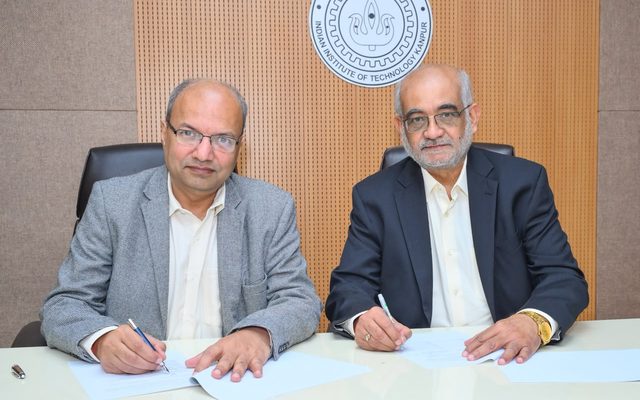






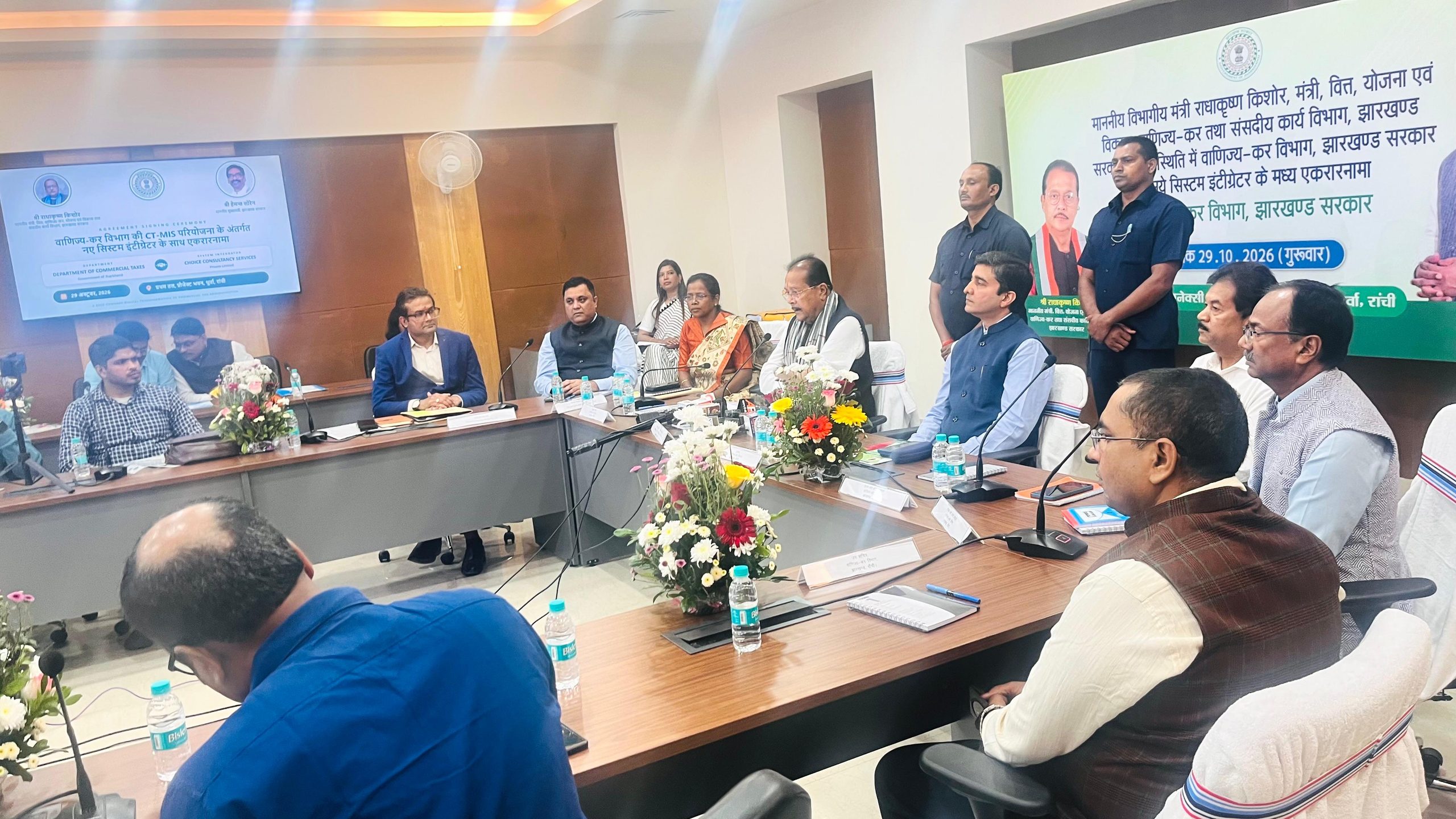
Ranchi: The state government of Jharkhand has taken a significant initiative to boost revenue collection, effectively control tax evasion, and strengthen coordination among various departments. Under the Commercial Taxes Department’s CT-MIS project, an ‘Integrated Revenue Intelligence System’ (IRIS) will be developed. An agreement to this effect was signed on Thursday between the department and ‘Choice Consultancy Services Private Limited’—the system integrator selected through a tendering process.
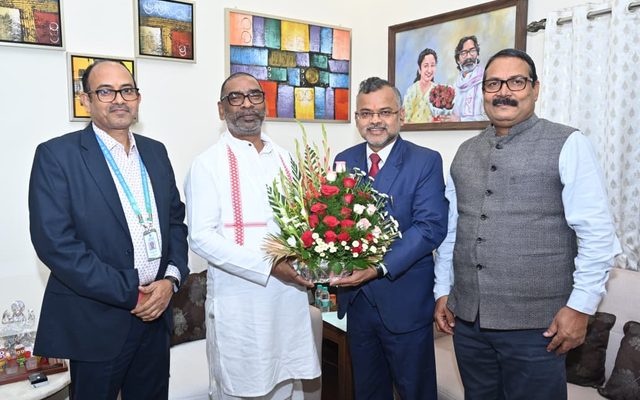
The agreement was signed at an event held at Project Bhawan, in the presence of Radhakrishna Kishore, Minister for Finance, Planning & Development, Commercial Taxes, and Parliamentary Affairs. Through the proposed system, online portals and databases of various departments will be integrated to analyze revenue-related information. The plan is to develop the IRIS within six months and subsequently implement it over the next three years.
Also Read: ONTHHPC Crowned Champions of 54th Nehru Junior Hockey Tournament After Three Years
A Significant Step Toward Strengthening the Revenue System: Finance Minister
Finance and Commercial Taxes Minister Radhakrishna Kishore stated that Jharkhand has been facing economic losses due to GST reforms, a reduction in grants under MGNREGA, and the provisions of the MMDR Act. To compensate for these losses, the state government is working with commitment to increase revenue collection through its own resources.
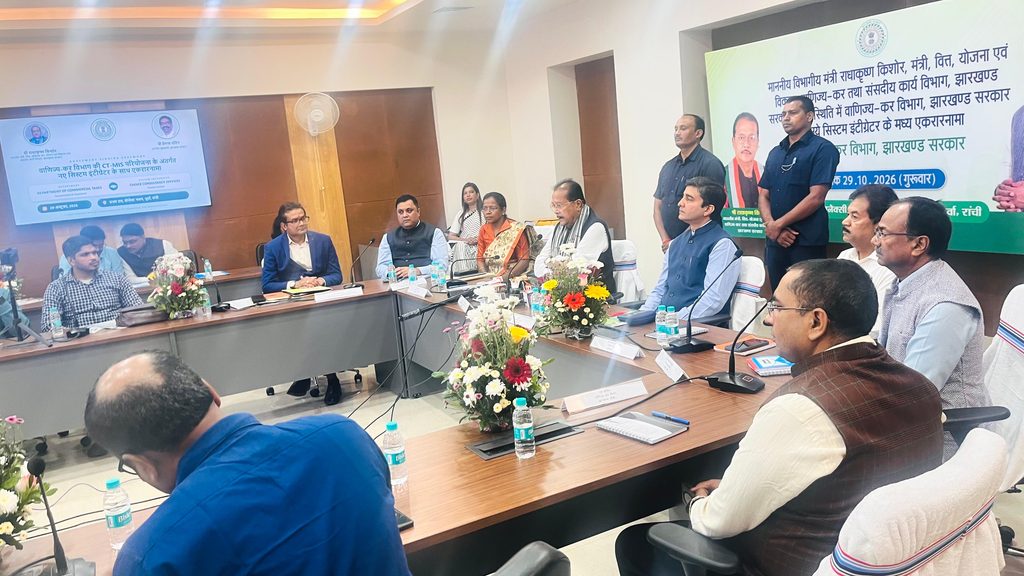
He noted that this initiative has been undertaken in line with the vision and leadership of Chief Minister Hemant Soren, with the aim of developing revenue-generation potential and making revenue collection more effective. A key objective is also to establish better coordination among the various departments responsible for revenue collection.
Describing the agreement as a milestone in strengthening Jharkhand’s revenue system, the Minister emphasized that a technology-driven, transparent, and effective revenue administration is essential for the state’s financial self-reliance. He also extended his congratulations and best wishes—on behalf of the Chief Minister and the Commercial Taxes Department—for the successful implementation of this initiative.
Also Read: High Court Quashes Government Order to Cancel JSSC-CGL; Relief for 1,932 Candidates
Claim of a ₹22,000 Crore Loss Due to Central Policies
The Finance Minister has claimed that Jharkhand is suffering an economic loss of approximately ₹22,000 crore due to the economic policies of the Central Government. He stated that despite being rich in mineral wealth, the state is forced to use its own resources to address the adverse impacts of mining activities—such as pollution, loss of forest cover, and public health issues—as well as to repair damage caused to roads.
According to the Minister, the state is incurring a loss of about ₹14,000 crore due to the MMDR (Mines and Minerals Development and Regulation) Act. Additionally, GST reforms and a reduction in grants under the MGNREGA scheme are each causing an economic loss of approximately ₹4,000 crore.
He emphasized that under these circumstances, it is essential to strengthen the state’s own revenue resources. The agreement signed under the CT-MIS project is a significant first step in this direction.
Identifying Tax Evasion through AI and Business Intelligence
Amit Kumar, Commissioner-cum-Secretary of Commercial Taxes, provided details regarding the technical structure and operational framework of the project. He explained that the new system integrator will establish integration between the IT applications and online portals of various state government departments involved in revenue collection.
The proposed IRIS system will utilize tools based on Business Intelligence (BI) and Artificial Intelligence (AI). By analyzing data collected from different departments, it will be possible to identify potential tax evasion and revenue leakage.
Based on the information generated by the system, the relevant departments will be able to take necessary action in accordance with the rules. This will improve the monitoring of revenue collection, strengthen inter-departmental coordination, and facilitate timely intervention against potential irregularities.
Integration of Portals Across Nine Key Sectors
To ensure the effectiveness of the IRIS system, API integration is proposed between the online portals of various departments. Key integrations will include:
- Mining Department: Integration of the Department of Mines and Geology’s JIMMS portal with the GSTN API. – Transport Department: Coordination of revenue-related information using the VAHAN portal.
- Works and IT Department: Integration of the WAMIS portal.
- Revenue Department: Coordination with the land registration portal.
- Urban Development Department: Integration of the property tax portal.
- Labour Department: Coordination of information with the labour cess portal.
- VAT and Excise Department: Linking the VAT portal with the VAHAN portal and the revenue portal of the Excise and Prohibition Department.
- JPT Portal: Integration with the trade licence portal of the Urban Development Department.
- JED Portal: Integration with the electricity billing portal of the Energy Department.
Consolidated analysis of the data obtained from these portals will facilitate better exchange of revenue-related information among various departments and help in identifying potential revenue losses.
Implementation of the system for three years
Under the project, the IRIS system is planned to be developed within six months. Following this, it will be implemented for a period of three years.
During the event, Subhash Pathak, a representative from Choice Consultancy Services Private Limited, provided an overview of the proposed system—covering its operational mechanism, technical architecture, and implementation aspects—through a PowerPoint presentation. He explained that integrating databases and online portals from various departments would enable a consolidated analysis of revenue-related information. This, in turn, will facilitate the identification of potential tax evasion and support timely action by the relevant departments.
The event was attended by Joint Secretary Poonam Kujur, Additional Commissioner of State Taxes Dilip Kumar Mandal, Jeevanarayan Mandal, and other departmental officials, along with representatives from the consultancy firm.
Through the IRIS system, the Government of Jharkhand aims to enhance the effectiveness of revenue collection, curb potential tax evasion, and strengthen technical coordination among various departments.

Related News
- Jharkhand ONTHHPC Crowned Champions of 54th Nehru Junior Hockey Tournament After Three Years
- Jharkhand High Court Quashes Government Order to Cancel JSSC-CGL; Relief for 1,932 Candidates
- Jharkhand DPS Ranchi Honours 145 Primary Wing Students for Academic Excellence
- Jharkhand Preservation of the Traditions, Culture, and Identity of the Tribal Community is Essential: Chief Minister Hemant Soren