



By: Mohammad Asif Siddiqui
Also Read: The hostel built for tribal girls has failed to support the students it was meant to help
Sativardha of Jamdhad has launched a puncture repair service, a beauty parlour and a cutlery shop just outside her home. She completed training for these jobs almost six months ago, after her higher secondary education, to make around Rs 5,000 every month.Her seven-member family used to migrate every year in search of work. Thanks to her enterprise, the family makes enough money now to give up the idea of migration altogether. “My father does not need to move out for work anymore.”

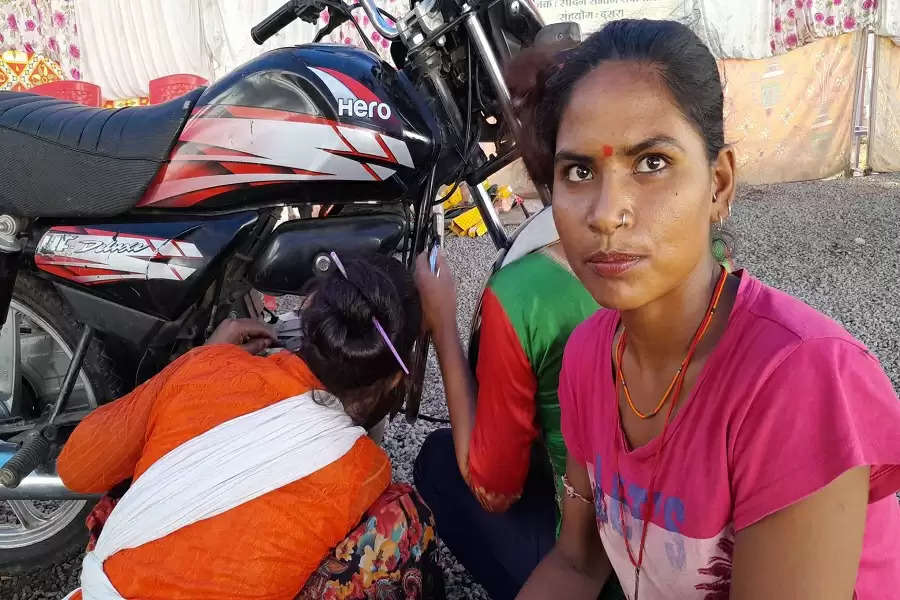
Six months ago, Gayatri Kasde of Sawali Kheda was trained as a mechanic under Babubhai, a mechanic in Khalwa town. Now she works from both Babubhai’s garage and her home.Radha Yadav of Bagda repairs motorcycles, besides running a grocery shop. She has managed to save Rs 15,000 over the last six months. Her brother, who was earlier working at a factory in Khandwa, has returned home to help run her business.
Also Read: The women behind Rajasthan’s cow dung cake economy
Sakiya Vardhaya belongs to a landless family from Jamdhad, comprising her parents, three sisters and two brothers, which migrated annually for work. She now repairs two-wheelers, assisted by her two sisters. The money she earns not only helps run the family but also takes care of her studies. Sakiya, a BA final year student, commutes daily to her college in Khandwa.
Most of these girls fall in the 18-24 age group and belong to the Gond and Korku tribes, which do not practise gender discrimination. So far, 50 girls have received training under the aegis of Spandan Samajsewa Samiti, a non-governmental organisation (NGO).
In search of fruitful employment, they approached NGO Spandan, which has been actively involved in stemming migration in Khalwa for many years. Initially, the girls were sent to local mechanics to acquire basic knowledge of repairing. Then came some financial assistance to open small shops adjoining their homes. Further training happened in Khandwa, followed by a five-day workshop in the first week of August to educate them about the finer points of repair.

Incidentally, the families wholeheartedly supported the girls right from the beginning. As Mantu points out: “When Seema didi of Spandan suggested that I take up garage work, I was enthused. I did not see anything wrong in doing the job.” Other girls chime in saying their families never stopped them. “We enjoy doing this work. It is true that many people doubt our skills, but we feel proud to earn our daily bread through hard work.”
According to Seema Prakash Michael of NGO Spandan, when they were looking at ways to stem migration, some girls suggested measures to generate local employment in Khalwa. They said they felt unsafe when family members went to other cities/towns in search of work. “After several rounds of discussions, we hit upon the idea of mobile and two-wheeler repairs. We were initially apprehensive, but the girls exhibited remarkable skills and enthusiasm. In fact, they surpassed all our expectations,” Michael says.


Related News
- Rights The hostel built for tribal girls has failed to support the students it was meant to help
- National The women behind Rajasthan’s cow dung cake economy
- Agriculture From cotton to millets: Rayagada’s tribal farmers make a switch
- Agriculture With Modi at helm, people needn’t be afraid of Lalu-Nitish: Shah