






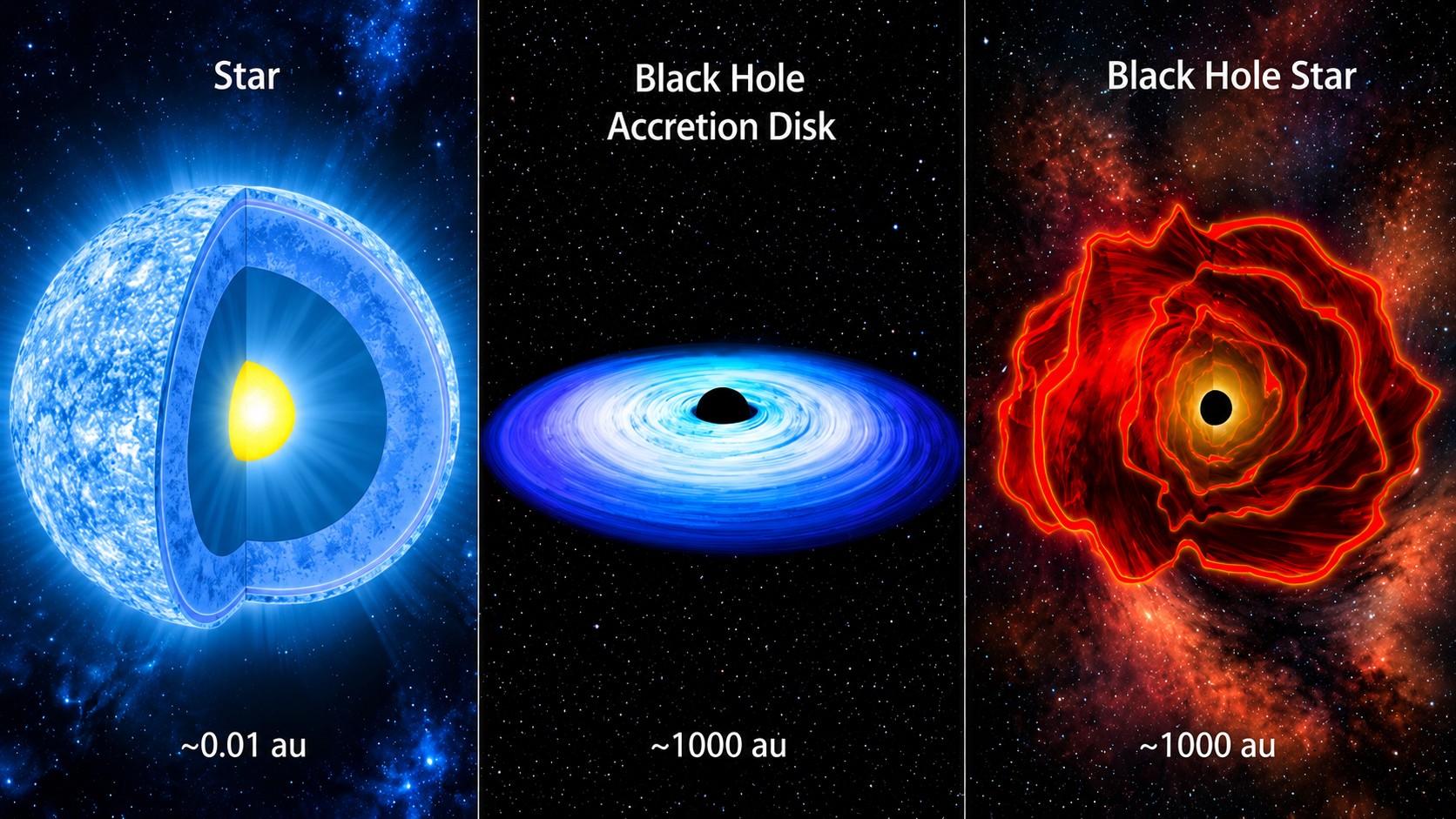
A never-before-seen fusion of a black hole and a massive star may hold the key to explaining the puzzling faint red specks that keep turning up in deep-space photographs.
Researchers from MIT and other institutions have identified an unusually brilliant red source deep in the early cosmos. At first glance, the object looks like a giant star roughly as wide as our entire solar system. Yet the amount of energy it’s giving off is staggering — about 100 billion times more than any ordinary star could ever generate. That kind of output points more toward black hole activity than standard stellar processes.
This strange mix of traits led the team to conclude they’d found something entirely unprecedented in astrophysics. They’ve named it a “black hole star.”
Also Read: Battery Draining Fast? 7 Phone Settings You Should Change Right Now
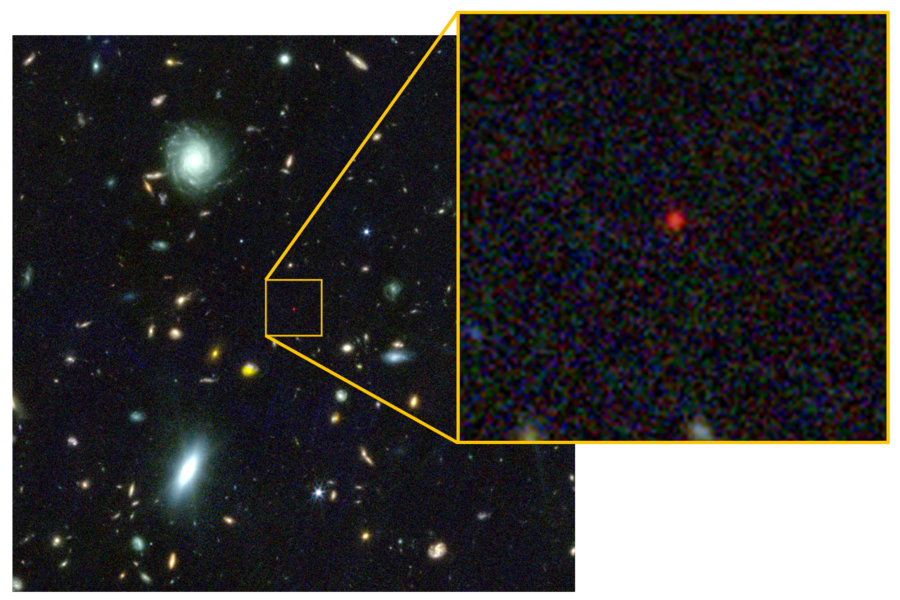
The findings, published today in Nature, describe how the object was picked up using NASA’s James Webb Space Telescope. It was located in the universe’s infancy, only a few hundred million years after the Big Bang.
According to the researchers, the best explanation for this odd red glow is that it represents a genuine hybrid part black hole, part star something never documented before. Their working theory is that it’s essentially an extremely compact, gas-heavy cloud, with a black hole at its core acting as the energy engine instead of the fusion reactions that typically power stars.
According to Rohan Naidu, the study’s lead author and a NASA Hubble Fellow along with a Pappalardo Fellow at MIT’s Kavli Institute for Astrophysics and Space Research, understanding of this object is changing fast as new analysis comes in. The team believes there is a central black hole that is 100,000 times as massive as the sun, surrounded by an extended gas envelope that resembles a star the size of the solar system.
Also Read: When Sumitra Died and Returned as Shiva: The Sumitra Reincarnation Case
Should this red dot turn out to genuinely be a black hole star, it could resolve a long-standing puzzle around similar faint red objects that JWST has captured in nearly all of its deep-space imagery so far.
Naidu notes that these small red points seem common throughout the early cosmos but vanish by the modern era, and pinning down their true nature has been one of the biggest open questions since JWST began operating.
Joining Naidu on the MIT side of the research are Kavli Institute Director Robert Simcoe, who holds the Bruno B. Rossi Professorship in Experimental Physics, and Wendy Sun, a member of the class of 2026 — alongside additional collaborators from several other research institutions.
Finding a black hole star was never part of the plan. Naidu and his team had set out searching for the earliest, most far-flung galaxies, through a survey they called “Mirage or Miracle” (MoM). Using JWST, they peered into deep space, back to when the universe was only a few hundred million years old, hoping to spot galaxies that had genuinely formed during that early era.
Naidu describes a long-standing puzzle where an unusually high number of bright galaxies kept appearing at these extremely early times. What their survey revealed was that something that initially looks like a strikingly bright early galaxy a “miracle” can sometimes turn out to be a “mirage” instead.
While scanning through JWST’s imagery to pick out promising targets for their survey, one particular feature caught their attention above all the rest: a dot that was strikingly red and unusually bright.